
Palm Desert House-History Sources
A house-history search needs an era map before it needs a name. Riverside County's recorder index, clerk index, assessor roll, GIS, and permit channels cover different facts. Federal census schedules add household structure only through the latest public year. Local city directories and Sanborn maps are useful only when a real Palm Desert or regional run is verified. The table shows what the assigned research actually establishes.
| Source | Years or coverage | Where held | What it shows |
|---|---|---|---|
| Recorder web index | January 1, 1974 to present | Riverside ACR self-service | Recorded parties, dates, and instrument clues |
| Earlier deed books and indexes | Before the web window | Riverside office and Gateway route | Older grantor-grantee chain; exact beginning not verified |
| Assessor and GIS | Current parcel and map context | Riverside County | APN, PIN, legal and parcel geography |
| Palm Desert permits | Clariti from October 27, 2025; older eTRAKiT by staff request | Development Services Center | Project, applicant, scope, and physical-change dates |
| Federal census | Public through 1950 | NARA and genealogy access | Named household and relationships at enumeration address |
| City and criss-cross directories | Exact Palm Desert run not verified | Library or archive research | Possible address-to-occupant snapshots |
Previous residents are therefore reconstructed from overlapping evidence. Title shows a recorded transfer. A directory can show an occupant. A newspaper or obituary can close a life-event gap. No one row should be asked to prove all three.
Palm Desert Parcel Starting Point
Start a previous-residents search with the present address and its Riverside parcel identifiers. Use the property address in the Assessor search, save the APN and PIN, and note the legal description, tract, map, and city or community label. Map My County can show the selected polygon, parcel report, assessor map, tract links, and nearby geography. Those keys are more durable than a postal label that may cross a city edge.
The county's copy instructions explain online, mail, and counter routes for recorded documents. The Palm Desert ACR counter is at 38-686 El Cerrito Road, with mail sent to P.O. Box 751 in Riverside. It does not accept mail at the counter. The recorded document itself, not a solicitation or commercial summary, is the source to preserve.
The Riverside official copy and access instructions are the source shown below.
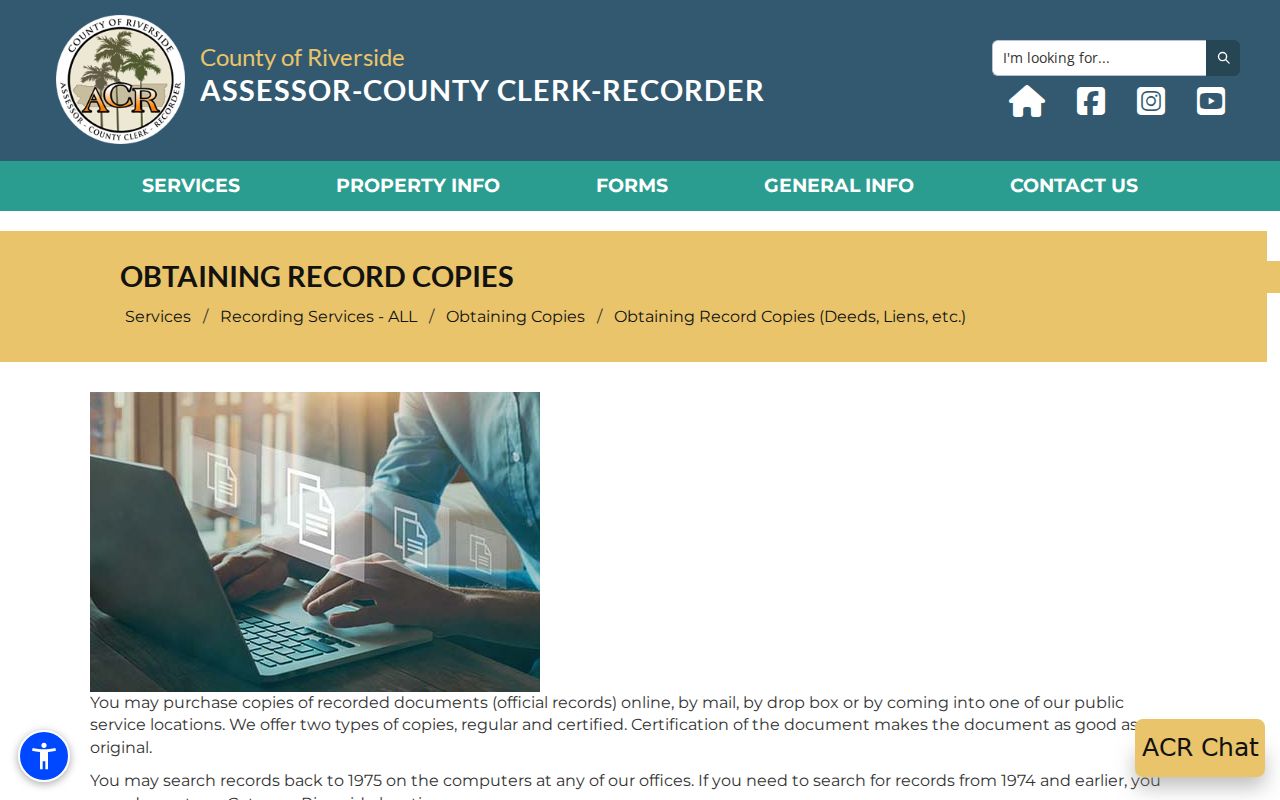
The copy route makes the key distinction clear: an index can start the search, while an ordered official image supports the deed-chain conclusion.
Palm Desert Deed Chain
A grantor is the party conveying an interest. A grantee is the party receiving it. A chain of title is the linked sequence of recorded transfers for the same land. A legal description identifies the land beyond a street label. These terms make the previous residents workflow precise, especially where a Palm Desert address changed or a party held title through a trust or entity.
- Normalize the present address through Riverside Assessor and save APN, PIN, legal description, tract, and map references.
- Search the current acquisition period in the recorder index using the owner's Last First MI name and likely deed clues.
- Read the instrument for the grantor, grantee, document number, date, and legal description. Reject a name match if the land description does not fit.
- Search the grantor as an earlier grantee within a prior date range, then repeat the same comparison.
- At the online boundary, take the last party and book-page clue to Gateway Riverside or the county's historical index route.
- Legal description
- The recorded land description, often tied to tract, lot, block, map, or parcel context.
- Chain of title
- The linked sequence of recorded interests, not a list of every person who occupied a home.
- Grantor and grantee
- The conveying and receiving roles in an instrument; both roles need to be read in context.
Palm Desert Recorder Since 1974
The Riverside recorder web index begins January 1, 1974, while clerk documents are indexed from January 1, 1893. The county's copy guidance separately says office computers search from 1975 and that pre-1975 research goes to Gateway Riverside. A Palm Desert previous-residents trail must show which access statement it used. Earlier deeds do not disappear because the web result ends.
Use the online name and date search to find the last accessible instrument. Capture its document number, parties, book or page clue, and legal description. Then ask the Recorder or Gateway office for the older grantor-grantee book or index. The county supports counter and mail copy routes, but a mail search with an unknown document number needs party names, estimated date, title or type, and parcel details.
Copies are paid and are not refundable after production. Treat the date range as a search limit, not as proof that the property had no earlier owner.
Palm Desert Legal Descriptions
Street addresses are useful search keys, but the legal description and APN are stronger continuity keys for previous residents. Palm Desert plans and engineering review use owner name, legal description, tract name and number, APN, easement deeds, conveyance deeds, lot and centerline calculations, and map references. Those details help determine whether an old instrument concerns the same land when a postal number, development name, or city label changes.
Mailing address and situs address also need separate notes. The situs is the physical parcel. The mailing address is a correspondence destination and may point elsewhere. A person named in a tax or deed record can have a connection to the land without being the person who lived there.
Continuity test. Keep APN, tract, lot, legal description, and document number together. A matching street line alone is too weak for a Palm Desert house history.
Palm Desert Previous Residents in Permits
Palm Desert's Development Services Center moved current permit work from eTRAKiT to Clariti on October 27, 2025. Clariti supports applications, plan uploads, tracking, inspections, and payment. Earlier eTRAKiT matters need staff help at 760-776-6430 or dscinfo@palmdesert.gov. A request should include the permit number, project address, and contact details.
Permit records can date new construction, a renovation, an encroachment, a pool-drain project, or an inspection. They may show an applicant, owner, contractor, parcel, scope, or plan contact. This is valuable physical-history evidence for previous residents, but it does not prove who occupied the home. A permit is a project record, not a household directory.
The Palm Desert permit center is the starting channel, with City Clerk or Development Services as the fallback for older records.
Palm Desert Previous Residents in Directories
City or criss-cross directories can add an occupant snapshot between deed dates. The assigned research did not verify a Palm Desert-specific year run, so the library and Historical Society must confirm whether a real volume contains an alphabetical section, street section, telephone line, owner or occupant mark, and abbreviation key. Search Palm Desert, Palm Village, Palm Springs, Indio, Coachella Valley, and Riverside County headings.
The Historical Society's oral histories, Hourglass newsletters, and Shadow Mountain Club newsletters can supply names, nicknames, club ties, and address context. They are strong leads for previous residents but not title proof. The Palm Desert directory book page explains the verified collections and the honest gap in exact publisher and year coverage.
Palm Desert Past Residents and Census
Federal census schedules are public through 1950 under the 72-year rule. A Palm Desert-area household may appear under an enumeration district or predecessor community rather than under today's city boundary. Pair the census household with the directory year, deed date, and parcel description. A census can show relationships at an address, while a deed can show a recorded land interest. Neither source alone supplies a complete occupancy timeline.
Regional newspapers add a different layer. The official history notes that the Indio Daily News began in 1912 as the weekly Indio Date Palm, later merged into The Desert Sun, whose publication schedule changed over time. Obituaries, society columns, property notices, and announcements can connect a name to a date or event. Verify a newspaper lead with a vital, probate, deed, or archive source.
Previous residents are best reported as dated evidence: “listed at this address in a directory,” “party to this deed,” or “named in this obituary,” rather than as an unsupported statement of continuous residence.
Palm Desert Previous Residents House History
No official assigned source confirmed a Palm Desert Sanborn sheet or year run. Sanborn maps should therefore be described as a possible library or catalog check, not as an available local set. Where no sheet is found, parcel maps, tract maps, aerial context, permits, plans, and recorded instruments can still show how a site changed.
Map My County can provide a selected polygon, parcel report, assessor map, tract links, measurements, and a printable map with title, legend, and notes. These tools help place an old legal description in present geography. They do not name every former occupant. Ask the library, Historical Society, and relevant archive whether a historic plan or aerial collection covers the address before drawing a conclusion from a blank map.
The absence of a verified Sanborn run is a real Palm Desert research gap. It is not evidence that a building never stood on the parcel.
Palm Desert Previous Residents Sources Compared
Previous residents of a Palm Desert address are most credible when three layers agree: a land record, a household or community source, and a dated event record. The land layer is the recorder and assessor chain. The household layer can be a directory, census schedule, oral history, newsletter, or newspaper. The event layer can be probate, obituary, vital record, permit, or court file.
Keep protected and private facts out of the trail. California Safe at Home, sealed records, DMV information, utility data, and household-member details can be unavailable by design. A missing person from an old source may reflect privacy, an unlisted household, a seasonal absence, or a place-name change. Do not fill the gap with a guessed address.
House-history use. Use the Palm Desert record trail for genealogy, stewardship of an old property, estate research, and lawful personal history. Do not use it to stalk, harass, intimidate, or harm a person.
The Palm Desert street directory route is the next step when the historic address needs a current parcel and deed check, while the city directory route remains the source for collection details.